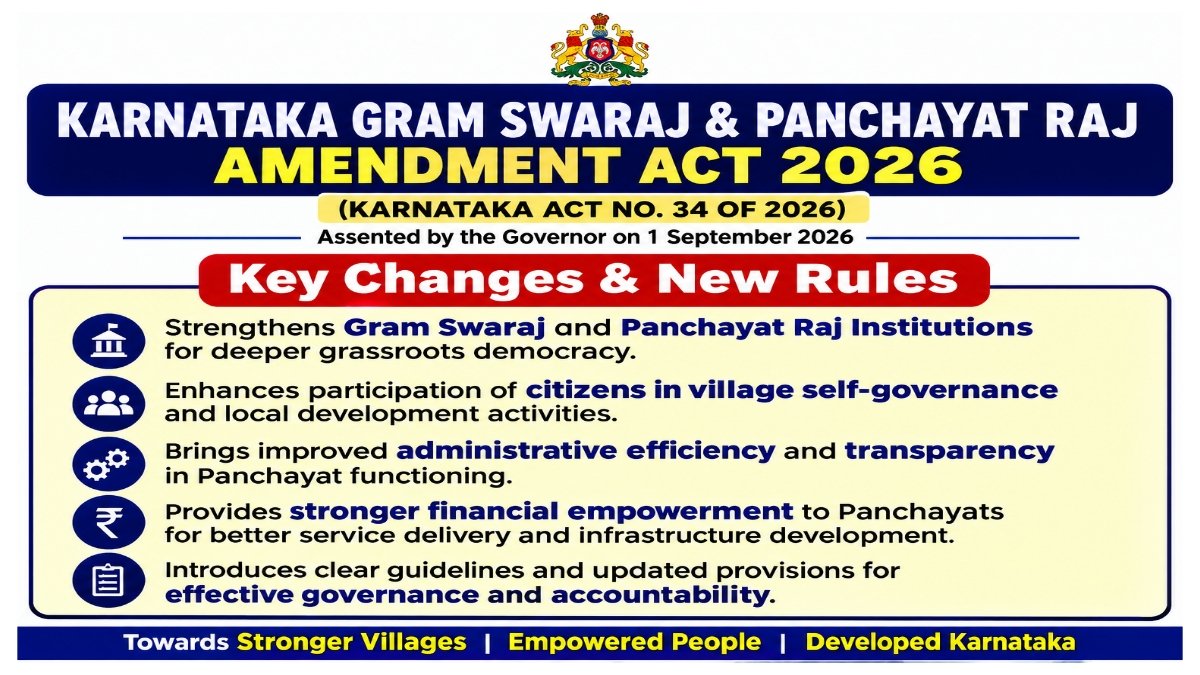
Karnataka Gram Swaraj & Panchayat Raj Amendment Act 2026: Key Changes & New Rules
Karnataka Gram Swaraj & Panchayat Raj Amendment Act 2026: Key Changes & New Rules: Karnataka Gram Swaraj and Panchayat Raj Second Amendment Act 2026: Check key changes on Public Streets, private roads, Section 63-A, Electoral Registration Officers and Gram Panchayat voter lists.
The Karnataka Gram Swaraj and Panchayat Raj (Second Amendment) Act, 2026 has been enacted to further amend the Karnataka Gram Swaraj and Panchayat Raj Act, 1993.
The new law is officially known as Karnataka Act No. 34 of 2026. It received the assent of the Governor of Karnataka on September 1, 2026, and was first published in the Karnataka Gazette Extraordinary on the same day.
The amendment introduces important provisions relating to public streets, private roads, road connectivity, compensation and electoral registration for Gram Panchayat constituencies.
Karnataka Act No. 34 of 2026 – Overview
Particulars Details Act Name Karnataka Gram Swaraj and Panchayat Raj (Second Amendment) Act, 2026 Act Number Karnataka Act No. 34 of 2026 Parent Act Karnataka Gram Swaraj and Panchayat Raj Act, 1993 Governor’s Assent September 1, 2026 Gazette Publication September 1, 2026 Effective Date July 16, 2026, unless otherwise provided State Karnataka
Major Changes Under the Amendment Act
The 2026 amendment makes several important changes to the Karnataka Gram Swaraj and Panchayat Raj Act, 1993.
1. New Definition of “Public Street”
Section 2, Clause (33) of the principal Act has been substituted with a new definition of “Public Street.”
A Public Street includes any:
- Street
- Road
- Square
- Court
- Alley
- Passage
- Riding path
over which the public has a right of way and which is maintained by Rural Local Bodies, the Government or any public authority.
The definition also includes:
- Roadways over public bridges or causeways
- Footways attached to such streets, bridges or causeways
- Drains attached to such streets, bridges or causeways
- Land situated on either side of the roadway up to the boundaries of adjacent property
The adjacent property may be private property or property belonging to the Government or Rural Local Bodies.
2. New Section 63-A – Power to Declare a Private Street as a Public Street
One of the major provisions introduced by the amendment is Section 63-A.
Under this provision, if a private street, including its drains, is in such poor condition that it poses a threat to public safety or public health, an authority authorised by the Government may initiate proceedings to declare the private street, or a part of it, as a Public Street.
The process may be initiated:
- On the authority’s own initiative; or
- On a request from the owners of the private street; or
- On a request from owners of buildings or lands fronting or abutting the street.
Objection Opportunity
Before declaring the private street as a Public Street, the authority must:
- Issue a public notice.
- Serve notice to the concerned owners.
- Allow owners or other interested persons to submit objections.
- Consider the objections received.
- Take a decision regarding declaration of the street or part of it as a Public Street.
The procedure and duration will be applicable as notified by the Government from time to time.
3. Road Must Have Public Connectivity
The amendment specifically provides that a private street proposed to be declared as a Public Street must have connectivity from a public road or Public Street.
This condition is important while determining whether a private street can be brought within the scope of the provision.
4. Roads Constructed Using Public Funds
The amendment also provides that a road which has been laid or constructed using funds from the public exchequer may be declared as a Public Street under Section 63-A.
This provision is particularly relevant to roads developed using public funds but which may otherwise be treated as private roads.
5. No Compensation in Certain Cases
Section 63-A(2) introduces an important provision concerning compensation.
Where an erstwhile landowner had shown a particular portion of land as a road in a registered deed of transfer or conveyance and had subsequently carved out and sold or transferred building sites benefiting from that road, the landowner will not be eligible for certain forms of compensation if the road is subsequently declared a Public Street.
The provision specifically refers to compensation under the Right to Fair Compensation and Transparency in Land Acquisition, Rehabilitation and Resettlement Act, 2013, or any other law.
It also includes Development Rights Certificates under Section 14-B of the Karnataka Town and Country Planning Act, 1961.
6. New Section 165A – Electoral Registration Officer
Another important change is the insertion of Section 165A relating to electoral registration.
Under this provision, an Electoral Registration Officer (ERO) will prepare and revise the voters’ list for each constituency of a Grama Panchayat in the prescribed manner.
The Electoral Registration Officer will be an officer of the Government or a local authority who is designated or nominated by the State Election Commission.
7. Booth Level Officers and Supervisors
The Electoral Registration Officer may, subject to prescribed restrictions, depute competent officials, Government employees or employees of local authorities as:
- Booth Level Officers (BLOs)
- Booth Level Officer Supervisors
These officials will assist in the preparation and revision of voters’ lists for Gram Panchayat constituencies.
8. Assistant Electoral Registration Officers
The State Election Commission may also designate one or more persons as Assistant Electoral Registration Officers (AEROs).
The AERO will assist the Electoral Registration Officer in performing his or her duties.
Subject to the control of the Electoral Registration Officer, an Assistant Electoral Registration Officer may perform all or any of the functions of the Electoral Registration Officer.
9. Power to Remove Difficulties
The Act gives the Government the power to address difficulties that may arise while implementing the provisions of the amendment.
If any difficulty arises, the Government may issue an order published in the Official Gazette containing measures considered necessary to remove such difficulty.
Such orders must subsequently be laid before both Houses of the State Legislature.
10. Repeal of Karnataka Ordinance No. 01 of 2026
The amendment Act repeals the Karnataka Gram Swaraj and Panchayat Raj (Amendment) Ordinance, 2026 (Karnataka Ordinance No. 01 of 2026).
However, actions already taken or deemed to have been taken under the repealed Ordinance will continue to be treated as actions taken under the new Amendment Act.
Effective Date
The Act generally provides that its provisions shall be deemed to have come into force from July 16, 2026, unless otherwise provided.
However, the newly inserted Section 165A relating to the Electoral Registration Officer comes into force from the date of publication of the Act in the Official Gazette, as specifically provided in the amendment.
Why Is This Amendment Important?
The Karnataka Gram Swaraj and Panchayat Raj (Second Amendment) Act, 2026 introduces significant changes in the administration of rural roads and Gram Panchayat electoral processes.
The provision relating to private streets provides a legal mechanism for certain private roads posing risks to public safety and health to be declared as Public Streets, subject to the prescribed procedure and opportunity for objections.
At the same time, the introduction of the Electoral Registration Officer, Assistant Electoral Registration Officer and Booth Level Officer system creates a specific statutory framework for preparing and revising voters’ lists for Gram Panchayat constituencies.
Key Highlights at a Glance
- Karnataka Act No. 34 of 2026 enacted.
- Governor’s assent received on September 1, 2026.
- Act published in the Karnataka Gazette Extraordinary on September 1, 2026.
- Karnataka Gram Swaraj and Panchayat Raj Act, 1993 further amended.
- New definition of Public Street introduced.
- New Section 63-A inserted.
- Certain private streets may be declared as Public Streets subject to conditions.
- Public connectivity is required for a private street proposed for declaration.
- Roads constructed using public funds can also be covered.
- New Section 165A introduces the Electoral Registration Officer framework.
- Provision made for Booth Level Officers and Supervisors.
- Provision made for Assistant Electoral Registration Officers.
- Karnataka Ordinance No. 01 of 2026 repealed with savings for actions already taken.
The Karnataka Gram Swaraj and Panchayat Raj (Second Amendment) Act, 2026 is an important amendment to Karnataka’s Panchayat Raj legal framework. Its key provisions address the status and management of certain private roads and establish a statutory mechanism for electoral registration and voter-list revision at the Gram Panchayat level.
Readers should refer to the official Gazette and the enacted legislation for the exact legal wording and interpretation of the provisions.